As an eBay Affiliate, Collector's Key may be compensated if you make a purchase through the link(s) above.
1875
| Weight | 2.5 g |
| Diameter | 17.9 mm |
| Mint | Philadelphia |
| Strike | Circulation strike |
| Mintage | 10,350,000 |
| Edge | Reeded |
| Alignment | ↑↓ Coin |
| Composition | 90% Silver, 10% Copper |
| Melt value | — |
| Designer | Christian Gobrecht |
| Collector's Key ID | CK-1855 |
Collection
Your collection
Sign in to track this coin.
One tap — add details later from your collection list.
No additional varieties recorded for this strike.
External references
Last edited: February 11, 2026
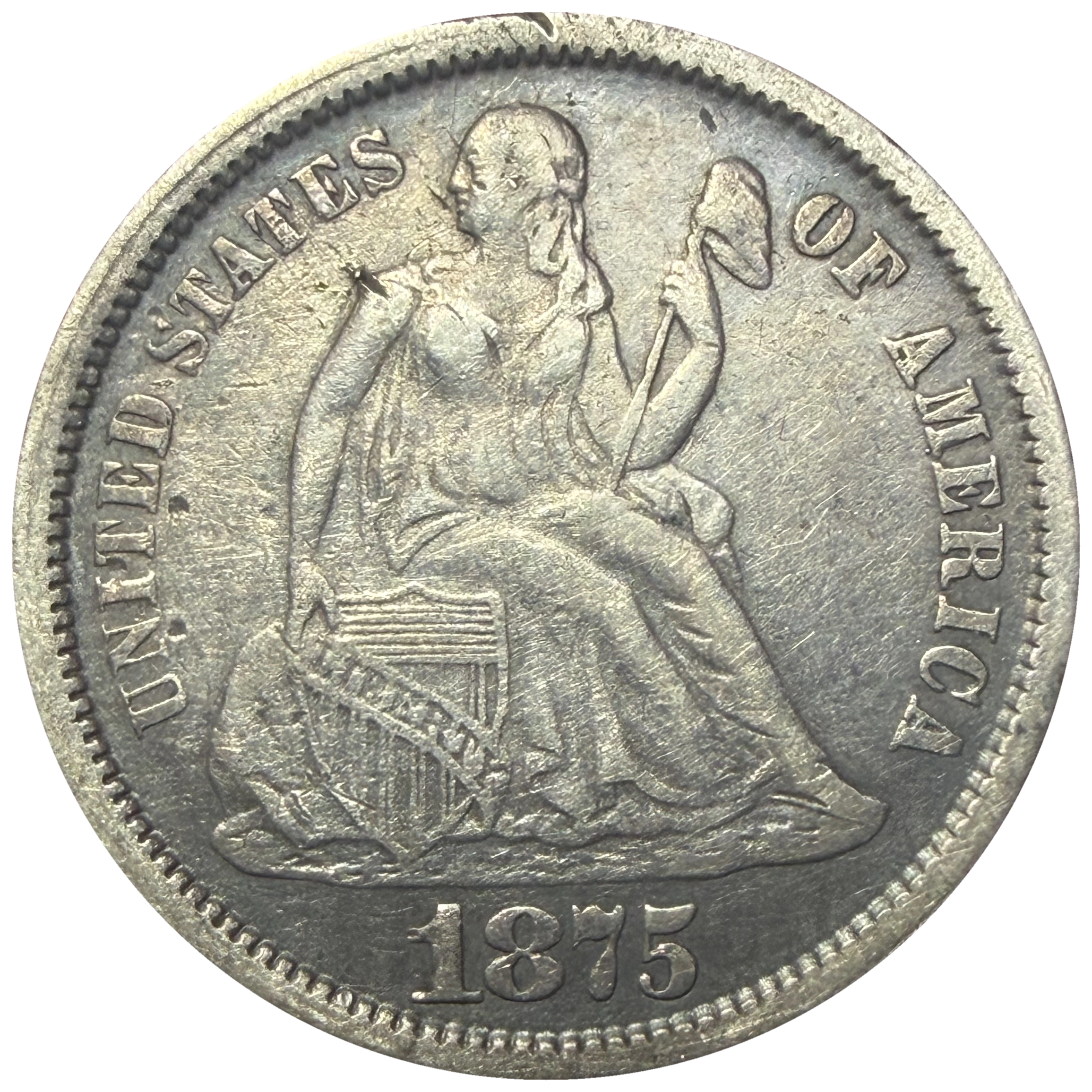
The 1875 Philadelphia dime opens the final Legend No Arrows subtype of the Seated Liberty Dime series and runs as one of the largest single-mint deliveries in the entire fifty-five-year design arc. Philadelphia struck 10,350,000 pieces during 1875, the largest Seated dime mintage at the main facility to that point, with the arrows that had marked the 1873-1874 Coinage Act weight change dropped from the dies at the start of the calendar year. Weight remains at the 2.50-gram post-Act standard, since the underlying weight specification did not change when the arrows came off, and the planchet stays at 90 percent silver. The surge in production reflects increased demand for small-change coinage after the silver three-cent piece and half dime were retired under the Coinage Act of February 12, 1873, leaving the dime as the principal sub-quarter denomination.
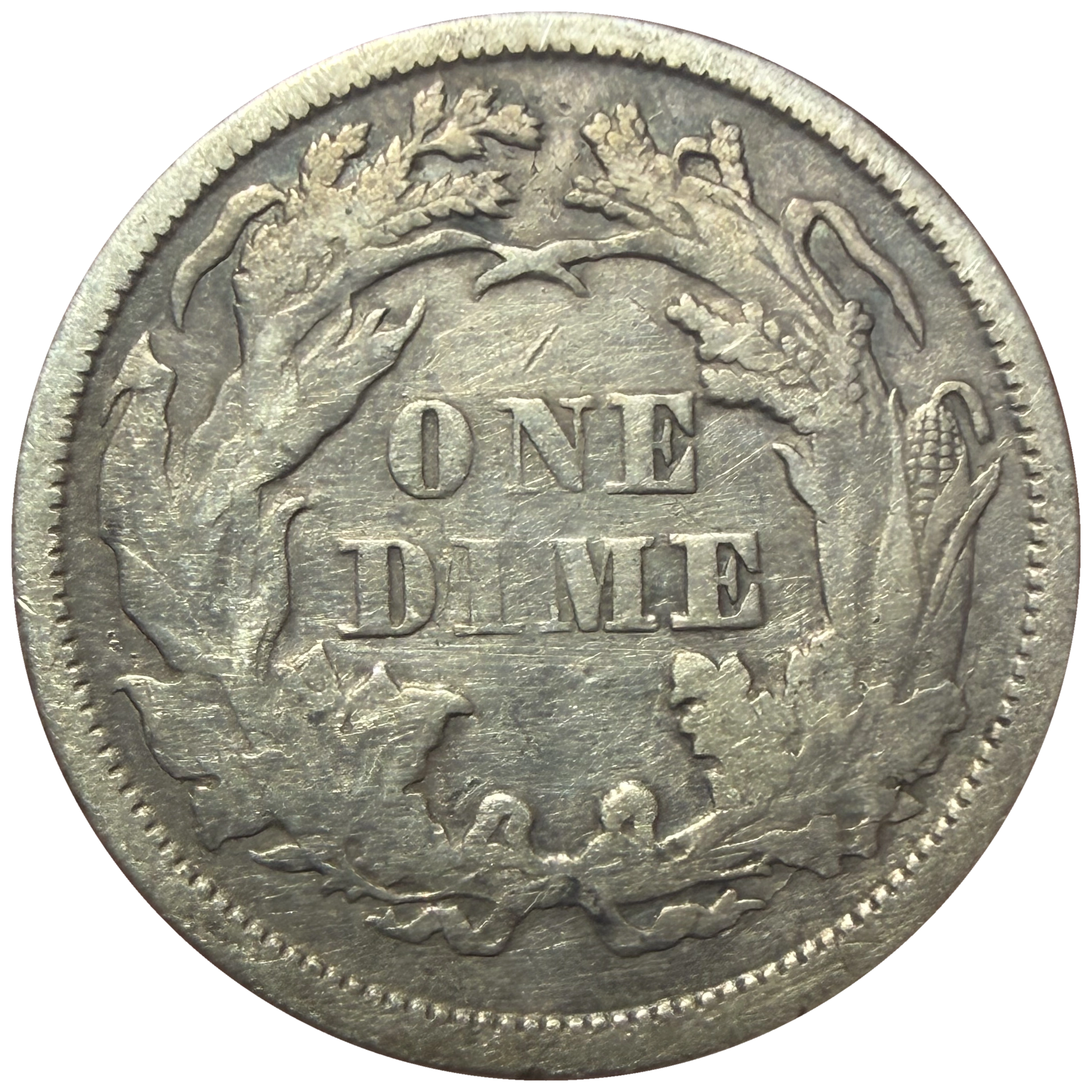
Strike quality on the 1875 reads as steady working Philadelphia output, with the new plain-date dies generally well-prepared and the wreath reverse and obverse legend coming up sharp on most early die states. Survival is broad and concentrates in the wide circulated range, with Very Good through About Uncirculated coins surfacing in volume and Mint State examples through MS-63 reasonably available. Above MS-64, the supply thins considerably, and pieces with full original satiny luster and clean fields trade at premiums that reflect that thinning rather than absolute scarcity. Authentication is straightforward and rests on the 2.50-gram weight, the 17.9-millimeter reeded edge, and the absence of arrows at the date, with the prior-year 1874 Arrows showing the small horizontal pellets at left and right of the numerals that the 1875 lacks. The Wiley-Bugert reference catalogs the year's substantial roster of working die marriages, with date position relative to the rock and minor design hub variations serving as the standard attribution markers.
The 1875 functions as the workhorse type-set anchor for the final Legend No Arrows subtype and a comfortable date-and-mint fill across worn grades. Pricing tracks generic Seated dime levels through About Uncirculated, runs to moderate premiums in MS-63 and MS-64, and steps up firmly in MS-65 and above where condition rarity carries the price rather than mintage scarcity. The Regular classification matches the market reality across the worn grades, with the upper Mint State range operating as a quiet condition challenge. For the broader story of Gobrecht's design, the 1873 Coinage Act, and the Carson City Mint, see the Seated Liberty Dime series history.
Reference data only — not an appraisal.
| Grade | Description | Low | High |
|---|---|---|---|
| G-4 | Good (G) | $15 | $17.50 |
| VG-8 | Very Good (VG) | $17 | $19.50 |
| F-12 | Fine (F) | $19 | $22 |
| VF-20 | Very Fine (VF) | $23 | $26 |
| EF-40 | Extremely Fine (EF) | $31 | $35 |
| AU-50 | About Uncirculated (AU) | $68 | $79 |
| MS-60 | Uncirculated (MS) | $124 | $143 |
| MS-63 | Choice Uncirculated (MS) | $270 | $285 |
How much is a 1875 Seated Liberty Dime worth?
How many 1875 Seated Liberty Dimes were minted?
What is a 1875 Seated Liberty Dime made of?
What is the melt value of a 1875 Seated Liberty Dime?
Is the 1875 Seated Liberty Dime a key date?
Live listings from eBay. As an eBay Affiliate, Collector's Key may be compensated if you click a link and make a purchase. See all on eBay →
It is important that you educate yourself on a coin before making a substantial purchase, as some coins on eBay could be counterfeit or misrepresented. eBay Money Back Guarantee protects the buyer in these cases.