As an eBay Affiliate, Collector's Key may be compensated if you make a purchase through the link(s) above.
1908
| Weight | 4.18 g |
| Diameter | 18 mm |
| Mint | Philadelphia |
| Strike | Circulation strike |
| Mintage | 565,057 |
| Edge | Reeded |
| Alignment | ↑↓ Coin |
| Composition | 90% Gold, 10% Copper |
| Melt value | — |
| Designer | Bela Lyon Pratt |
| Collector's Key ID | CK-5592 |
Collection
Your collection
Sign in to track this coin.
One tap — add details later from your collection list.
No additional varieties recorded for this strike.
External references
Last edited: April 25, 2026
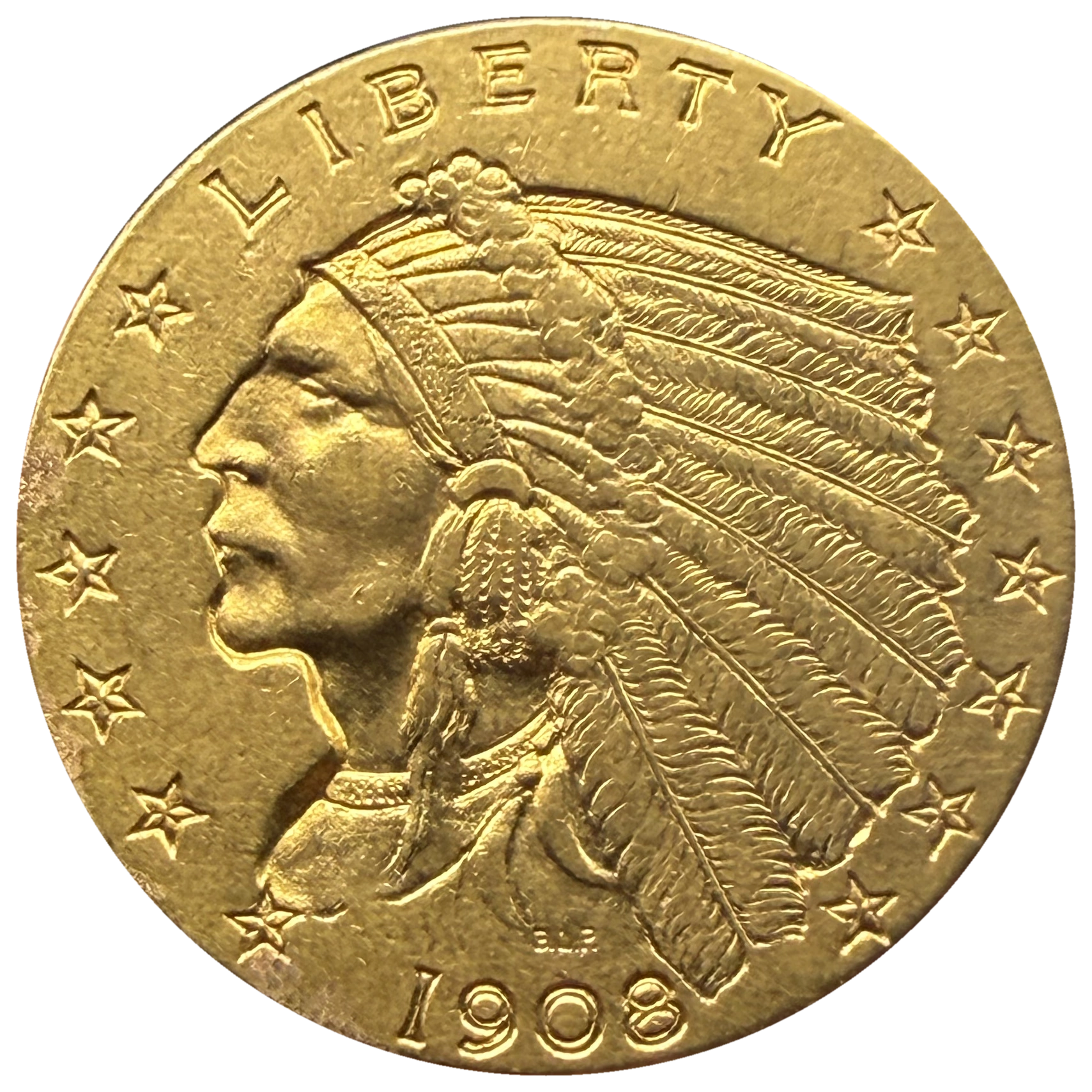
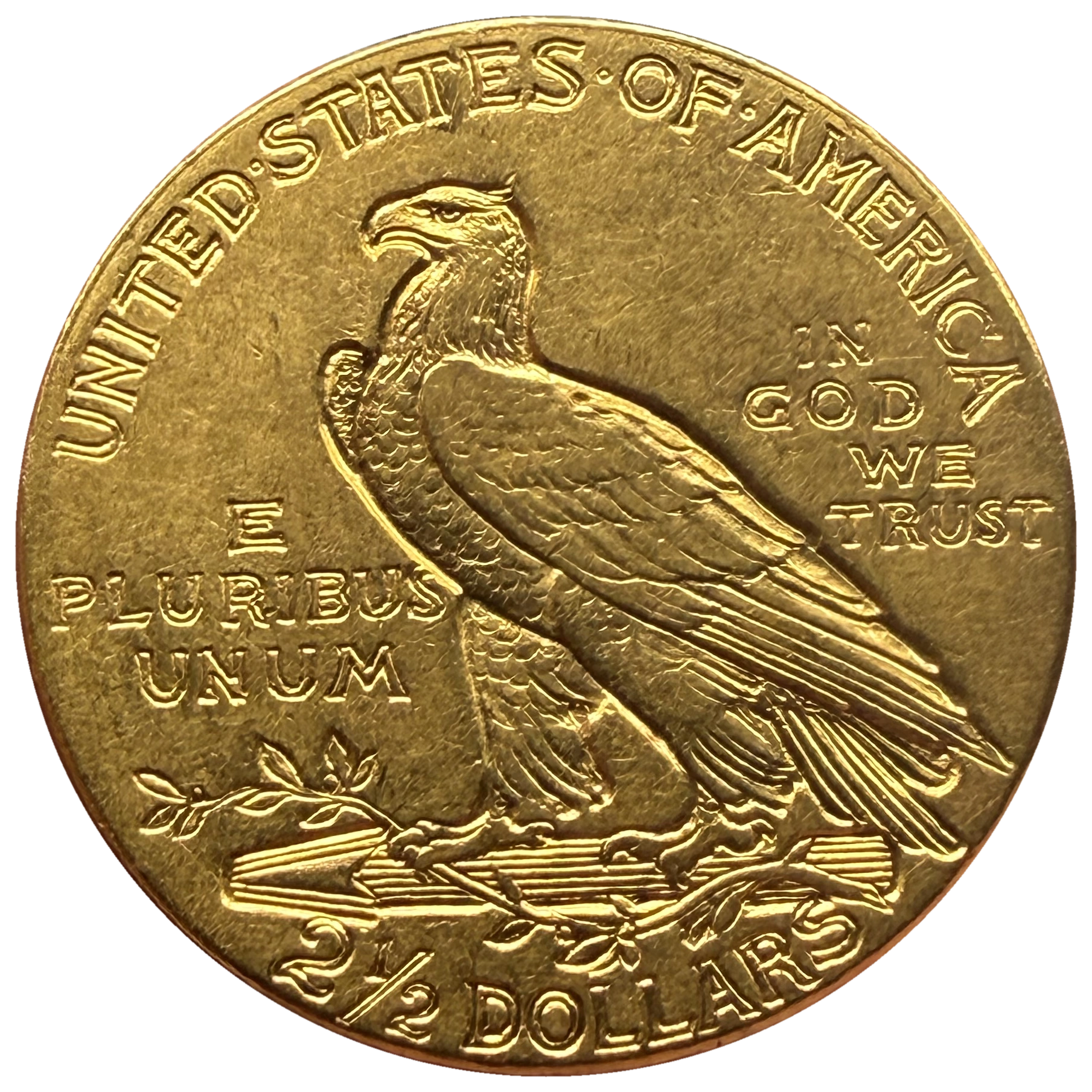
The 1908 quarter eagle introduced Bela Lyon Pratt's incused design, a radical departure from every gold coin the United States Mint had produced in more than a century. Where convention demanded raised devices and lettering, Pratt sank his Native American chief and standing eagle directly into the planchet, leaving the highest points of the design flush with the field. A student of Augustus Saint-Gaudens, Pratt drew the technique from ancient Egyptian carving and from Roosevelt's continuing push to modernize American coinage. Philadelphia struck 565,057 pieces in this first year, paired with a companion incused half eagle, replacing the long-running Liberty Head designs. Public reception split immediately. Philadelphia coin dealer Samuel H. Chapman published a widely circulated open letter in late 1908 arguing that the recessed surfaces would trap dirt, that counterfeits would prove undetectable, and that the design lacked dignity, criticisms the Mint rejected but that shadowed the series throughout its production life.
Authentication begins with the basic specifications: 4.18 grams of 0.900 fine gold, 18 millimeters across, a reeded edge, and the medal alignment adopted as Mint standard the previous year. The incused execution is itself the primary diagnostic. Genuine examples show the Indian's headdress feathers, cheekbone, and the eagle's plumage cleanly recessed below an unbroken field, with the field carrying the original mint luster rather than the design elements. Cast counterfeits, the most common threat to this type, betray themselves through soft edges on the recessed devices, mushy denticles along the rim, weight outside a narrow tolerance, and granular field texture inconsistent with struck coinage.
For modern collectors the 1908 functions as the entry point to the entire incused series and the date most often chosen for type representation. Circulated and lower Mint State examples trade close to bullion-influenced levels, reflecting the sizable mintage and broad survival across grades. The market tightens at MS64 and accelerates sharply through MS65 and above, where original satin luster, mark-free fields, and full definition on the chief's headdress converge only on carefully preserved coins. Matte proofs exist for 1908 and trade in a separate specialty market. Whether bought as a first-year-of-type acquisition or simply the most accessible incused quarter eagle, the 1908 anchors the series at its origin. See the full Indian Head Quarter Eagle series history.
Reference data only — not an appraisal.
| Grade | Description | Low | High |
|---|---|---|---|
| G-4 | Good (G) | — | — |
| VG-8 | Very Good (VG) | — | — |
| F-12 | Fine (F) | — | — |
| VF-20 | Very Fine (VF) | $575 | $665 |
| EF-40 | Extremely Fine (EF) | $595 | $685 |
| AU-50 | About Uncirculated (AU) | $615 | $705 |
| MS-60 | Uncirculated (MS) | $630 | $730 |
| MS-63 | Choice Uncirculated (MS) | $1,550 | $1,645 |
How much is a 1908 Indian Head Gold $2.5 Quarter Eagle worth?
How many 1908 Indian Head Gold $2.5 Quarter Eagles were minted?
What is a 1908 Indian Head Gold $2.5 Quarter Eagle made of?
What is the melt value of a 1908 Indian Head Gold $2.5 Quarter Eagle?
Is the 1908 Indian Head Gold $2.5 Quarter Eagle a key date?
Live listings from eBay. As an eBay Affiliate, Collector's Key may be compensated if you click a link and make a purchase. See all on eBay →
It is important that you educate yourself on a coin before making a substantial purchase, as some coins on eBay could be counterfeit or misrepresented. eBay Money Back Guarantee protects the buyer in these cases.