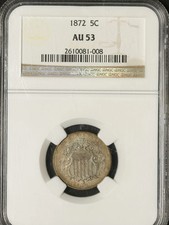
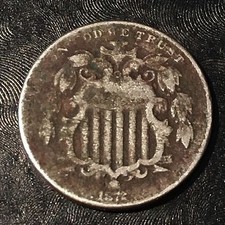
1872 Shield Nickel
| Weight | 5 grams |
| Diameter | 20.5 mm |
| Mint | Philadelphia |
| Mintage | 6,036,000 |
| Edge | Plain |
| Alignment | ↑↓ Coin |
| Composition | 75% Copper, 25% Nickel |
| Designer | James B. Longacre |
| Collector's Key ID | CK-1165 |
Production ticked up to 6,036,000 in 1872, a partial recovery from the 1871 cliff but still well below the eight-figure outputs of the late 1860s. The modest rebound would not last. By 1874 mintage would drop again as the Panic of 1873 began squeezing commercial demand across the entire economy, and the 1872 turns out to be a brief moment of restored mid-range production inside an overall declining trend. For collectors, it is one of the more comfortable early-1870s dates by a narrow margin.
PCGS estimates approximately 8,000 survivors across all grades, with around 750 in MS60 or better and 125 at MS65 or better. The auction record is $25,850 for an MS67 CAC sold by Stack's Bowers in November 2013, with the finest single example being an MS67 in the Greenbrier River Collection. The CAC sticker on the record sale reflects the premium that strong-eye-appeal examples command in the modern Shield nickel market, where many certified coins suffer from the usual die-state weaknesses and a genuinely sharp piece is harder to find than the population numbers alone suggest.
1872 saw the Credit Mobilier scandal break in September, when the New York Sun published documents showing Union Pacific insiders had distributed railroad stock to members of Congress to head off investigation of the transcontinental construction fraud. Grant won re-election that November against Horace Greeley, the Liberal Republican and New-York Tribune editor who died before the electoral votes were counted. Philadelphia was striking Shield nickels throughout, and the year's coins circulated through a political environment where the federal government was being publicly implicated in the same kind of railroad-related chicanery the 1869 Black Friday panic had first exposed.
The 1872 is more available than the 1871 semi-key but less common than the early high-mintage dates. Specialists pursuing high-grade examples find it more challenging than the 1866 through 1869 dates because the smaller mintage produced a smaller surviving population at every grade level.
| Grade | Description | Typical Price |
|---|---|---|
| G-4 | Good (G) | $33–$38 |
| VG-8 | Very Good (VG) | $40–$46 |
| F-12 | Fine (F) | $76–$88 |
| VF-20 | Very Fine (VF) | $94–$108 |
| EF-40 | Extremely Fine (EF) | $105–$122 |
| AU-50 | About Uncirculated (AU) | $141–$163 |
| MS-60 | Uncirculated (MS) | $188–$215 |
| MS-63 | Choice Uncirculated (MS) | $320–$340 |
This table is for educational purposes only and is intended to illustrate general market price trends and pricing steps between grades. Actual market conditions may vary significantly, especially for rarer pieces that often command premiums above the ranges shown here.




Listings refreshed hourly from eBay. When you interact with these links, Collector's Key may earn a commission through the eBay Partner Network.