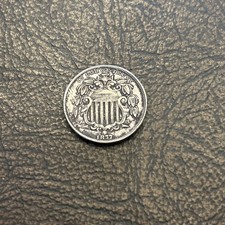
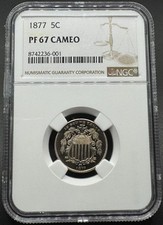
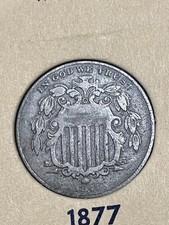
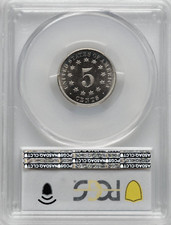
1877 Proof Shield Nickel
| Weight | 5 grams |
| Diameter | 20.5 mm |
| Mint | Philadelphia |
| Mintage | 900 Proof only |
| Edge | Plain |
| Alignment | ↑↓ Coin |
| Composition | 75% Copper, 25% Nickel |
| Designer | James B. Longacre |
| Collector's Key ID | CK-1176 |
No circulation strikes left Philadelphia in 1877. Per Ron Guth (PCGS), "the U.S. Mint at Philadelphia produced no Shield Nickels for circulation in 1877 and 1878." The cause was the straightforward absence of commercial demand in the depression's bottom years. Existing coinage from earlier mintages handled the remaining small-change volume, and the Mint suspended business strike production for both years. Only the proof program continued, as a token gesture to collectors and to maintain the denomination's technical existence on the Mint's production schedule.
The proof mintage figure has itself been the subject of specialist revision. Standard references long cited 510 pieces (the figure matching silver proof set sales), but R.W. Julian's research in Mint medal department correspondence at the National Archives produced a revised estimate of approximately 900 pieces, indicating the 1877 proof could be purchased independently of the silver proof sets. Whichever figure is accepted, the 1877 proof-only status makes it a mandatory acquisition for any collector assembling a complete Shield nickel date set because no circulation alternative exists. PCGS estimates approximately 575 survivors across all grades, with around 500 in PR60 or better and 325 at PR65 or better. The high survival rate relative to original mintage reflects deliberate contemporary preservation by collectors who recognized the proof-only year as a future scarcity. The auction record is $8,625 for a PR67 sold by American Numismatic Rarities in May 2005, with the finest known being multiple PR66 examples.
The Great Railroad Strike erupted on July 14, 1877, when rail workers in Martinsburg, West Virginia walked off the job to protest a third consecutive wage cut. The strike spread rapidly through Maryland, Pennsylvania, Illinois, and Missouri, and federal troops were called out before the unrest ended. More than a hundred people died before the strike collapsed in early August. The Philadelphia Mint struck its 1877 proofs during and after the strike, producing a few hundred specimen coins for collectors while the worst labor violence of the decade was unfolding a few hundred miles west. The 1877 proof carries premium pricing today driven by its proof-only status. Absolute scarcity is modest given the high survival rate, and Heritage and Stack's Bowers both offer certified examples regularly.
| Grade | Description | Typical Price |
|---|---|---|
| PR-63 | Proof (PR) | $3,090–$3,270 |
This table is for educational purposes only and is intended to illustrate general market price trends and pricing steps between grades. Actual market conditions may vary significantly, especially for rarer pieces that often command premiums above the ranges shown here.


Listings refreshed hourly from eBay. When you interact with these links, Collector's Key may earn a commission through the eBay Partner Network.