As an eBay Affiliate, Collector's Key may be compensated if you make a purchase through the link(s) above.
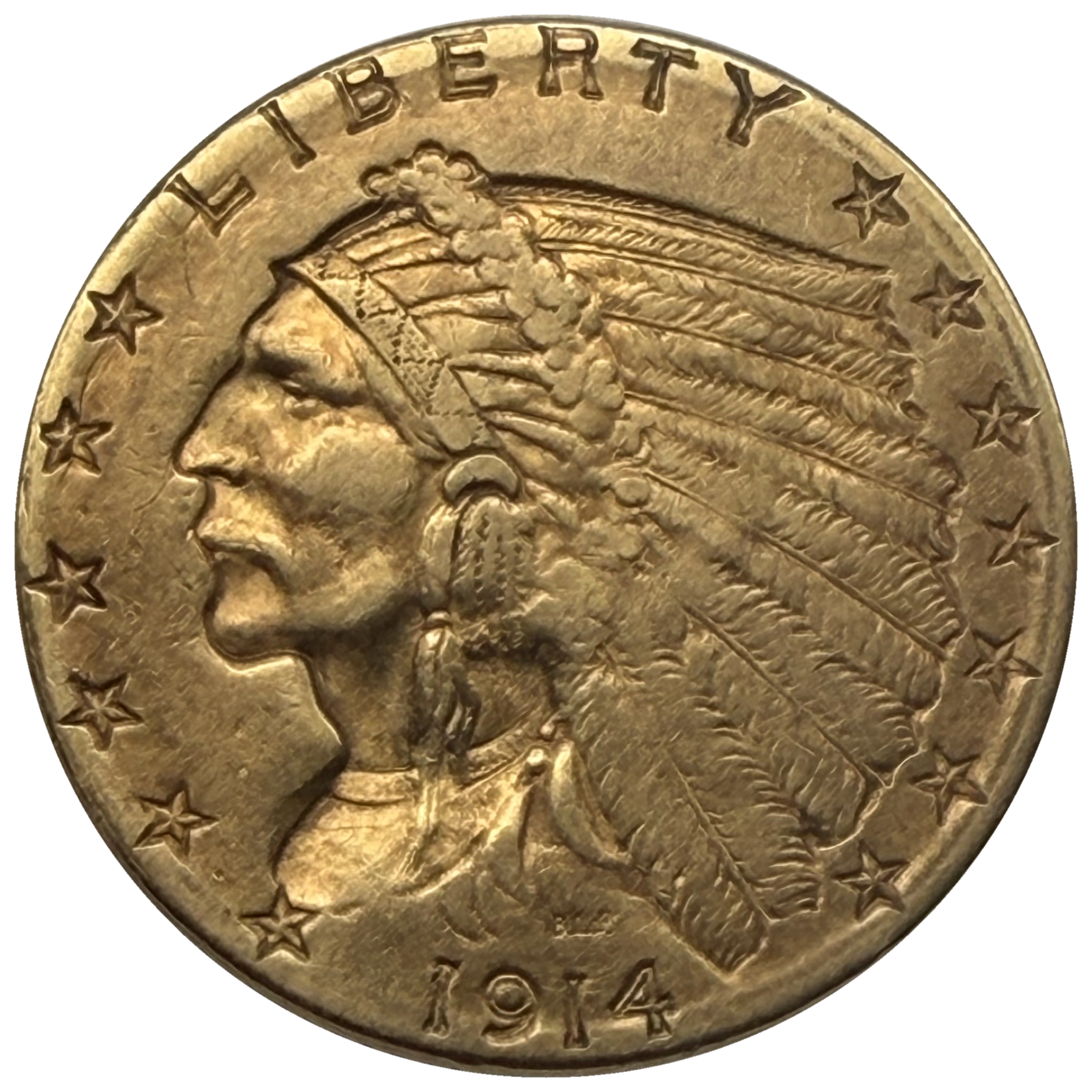
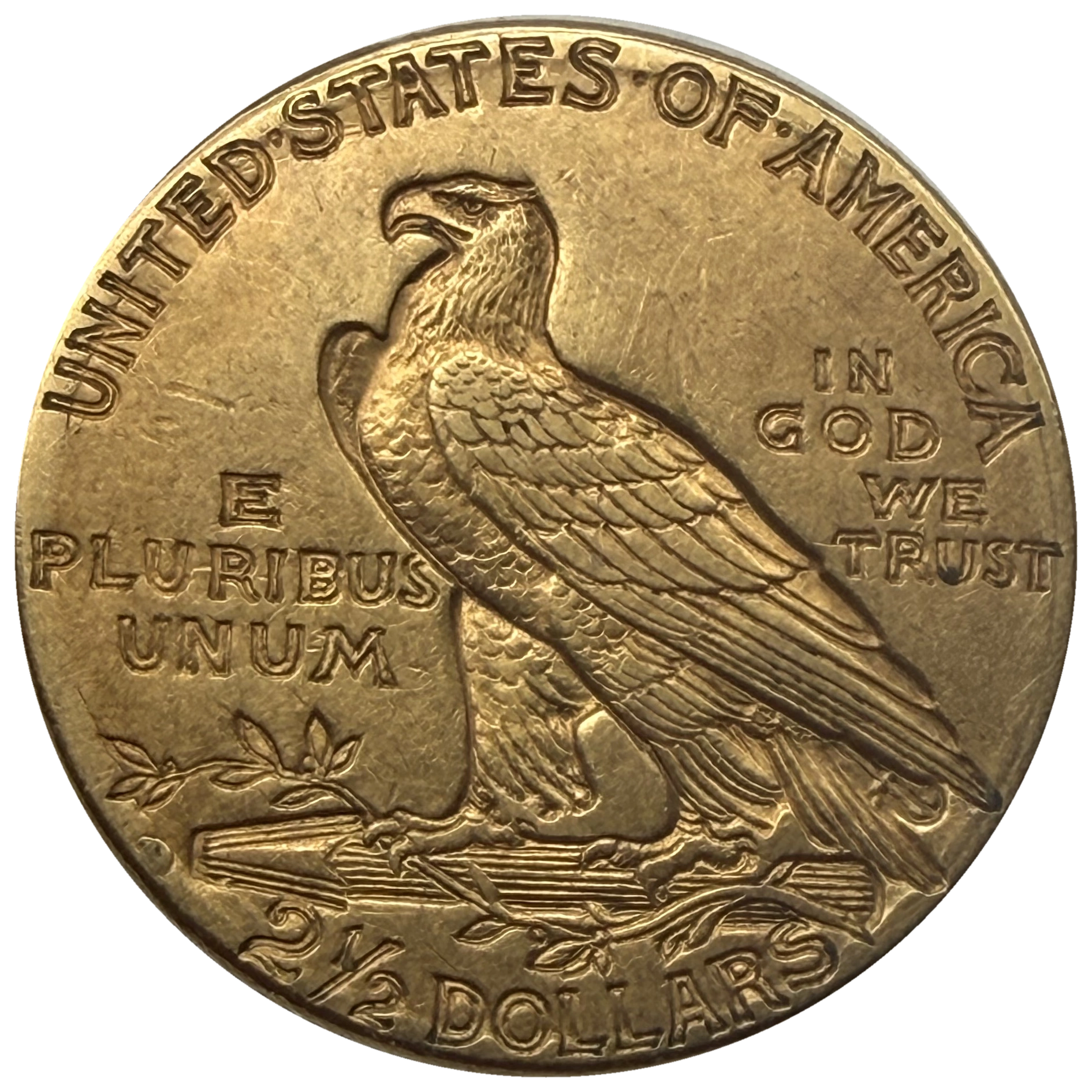
1914-D
| Weight | 4.18 g |
| Diameter | 18 mm |
| Mint | Denver |
| Strike | Circulation strike |
| Mintage | 448,000 |
| Edge | Reeded |
| Alignment | ↑↓ Coin |
| Composition | 90% Gold, 10% Copper |
| Melt value | — |
| Designer | Bela Lyon Pratt |
| Collector's Key ID | CK-5607 |
Collection
Your collection
Sign in to track this coin.
One tap — add details later from your collection list.
No additional varieties recorded for this strike.
External references
Last edited: April 25, 2026
Denver struck 448,000 Quarter Eagles in 1914, returning to the denomination after a three-year pause and producing a coin nearly eight times more plentiful than the rare 1911-D that had preceded it. The branch mint that year was processing fresh bullion from the booming Mountain West gold fields, and the comparatively generous mintage reflected steady regional demand for small gold rather than the constrained ceremonial output that had characterized the 1911-D issue. Europe slipped into general war that August as Austria-Hungary invaded Serbia, but the United States remained officially neutral, and American gold coin production continued at its established peacetime rhythm. The 1914-D occupies the middle position among the three Denver Indian Head Quarter Eagles, sitting between the 1911-D key and the 1925-D, and gave Western banks a coin whose recessed Pratt design proved durable enough for the rough handling typical of frontier circulation.
Authenticators evaluating a 1914-D should begin with the D mintmark on the reverse, positioned to the left of the arrows beneath the eagle, where genuine examples display a bold and well-defined letter that stands distinct from the field rather than the soft or mushy impressions seen on added-mintmark alterations attached from a 1914 Philadelphia coin. Weight should register 4.18 grams within tight tolerance, since shaved or cast counterfeits typically miss this benchmark by detectable margins. The incused design integrity is critical: Pratt's recessed devices should show sharp vertical walls within the planchet, with crisp lettering and feather detail that cast forgeries cannot replicate cleanly. Cast counterfeit detection further relies on examining the reeded edge for soft or interrupted grooves, checking surfaces under magnification for the granular pebbled texture characteristic of mold-made fakes, and verifying mint luster within the recessed areas.
For modern collectors, the 1914-D is the affordable Denver option in the Indian Head Quarter Eagle series, available across all circulated grades at modest premiums over melt and obtainable in lower Mint State without significant difficulty. The coin develops conditional rarity above MS64, where clean fields and full mintmark definition become genuinely scarce, but it never approaches the absolute rarity of its 1911-D sibling. See the full Indian Head Quarter Eagle series history.
Reference data only — not an appraisal.
| Grade | Description | Low | High |
|---|---|---|---|
| G-4 | Good (G) | — | — |
| VG-8 | Very Good (VG) | — | — |
| F-12 | Fine (F) | — | — |
| VF-20 | Very Fine (VF) | $575 | $665 |
| EF-40 | Extremely Fine (EF) | $595 | $685 |
| AU-50 | About Uncirculated (AU) | $615 | $705 |
| MS-60 | Uncirculated (MS) | $630 | $730 |
| MS-63 | Choice Uncirculated (MS) | $1,945 | $2,060 |
How much is a 1914-D Indian Head Gold $2.5 Quarter Eagle worth?
How many 1914-D Indian Head Gold $2.5 Quarter Eagles were minted?
What is a 1914-D Indian Head Gold $2.5 Quarter Eagle made of?
What is the melt value of a 1914-D Indian Head Gold $2.5 Quarter Eagle?
Is the 1914-D Indian Head Gold $2.5 Quarter Eagle a key date?
Live listings from eBay. As an eBay Affiliate, Collector's Key may be compensated if you click a link and make a purchase. See all on eBay →
It is important that you educate yourself on a coin before making a substantial purchase, as some coins on eBay could be counterfeit or misrepresented. eBay Money Back Guarantee protects the buyer in these cases.