As an eBay Affiliate, Collector's Key may be compensated if you make a purchase through the link(s) above.
1796 With Pole
| Weight | 5.44 g |
| Diameter | 23.5 mm |
| Mint | Philadelphia |
| Strike | Circulation strike |
| Mintage | 1,390 Combined mintage for all 1796 varieties |
| Edge | Plain |
| Alignment | ↑↓ Coin |
| Composition | 100% Copper |
| Melt value | — |
| Designer | Unknown |
| Collector's Key ID | CK-12 |
Collection
Your collection
Sign in to track this coin.
One tap — add details later from your collection list.
Other recorded varieties for 1796:
- 1796 No Pole · No Pole
External references
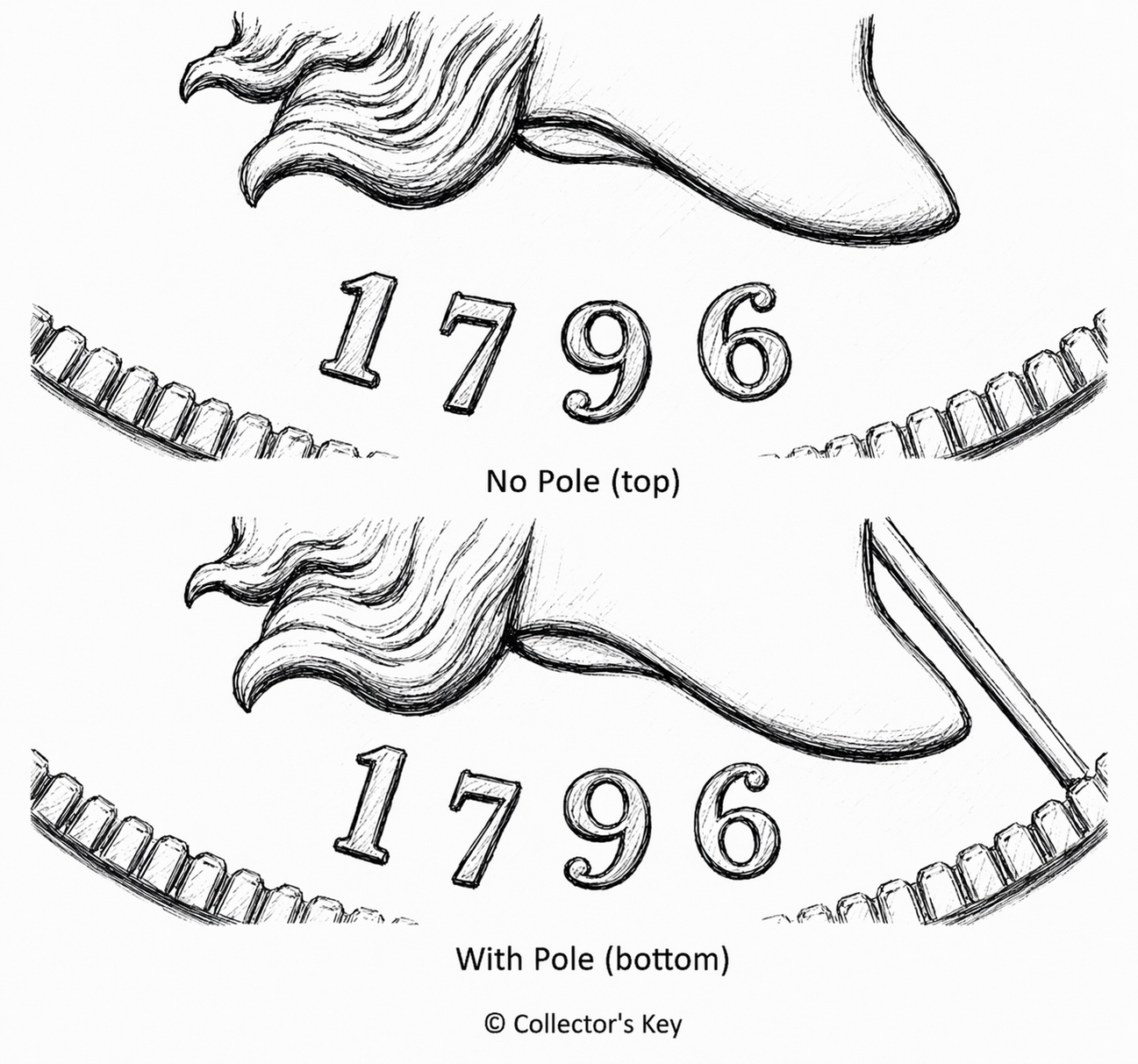
No Pole (top) vs With Pole (bottom): the liberty pole behind Liberty's cap was lapped away during die maintenance.
The 1796 With Pole half cent is the "complete" version of the design: Liberty wearing the Phrygian cap atop its pole, exactly as the engraver intended. It shares the 1796 date's total mintage of 1,390 coins with the No Pole variety, making both issues among the rarest in the entire half cent denomination. How many of those 1,390 coins were struck from the With Pole die versus the No Pole die is unknown, and survival rates for each variety have been estimated from census data rather than production records.
The With Pole variety is more common than the No Pole; PCGS estimates about 110 survivors, roughly four times the No Pole population. In absolute terms, either variety is a major rarity. The 1796 date is the coin that separates casual half cent collectors from serious ones, because acquiring one in any condition requires both money and patience. Clean, problem-free examples in any grade rarely appear at auction more than a handful of times per year, and when they do, the bidding reflects both the coin's rarity and its status as the key to the Liberty Cap set.
Grading standards for the 1796 are adjusted by the realities of supply. A collector who would insist on Very Fine or better for a common date must accept Good or Very Good for a 1796 and consider it a fine example. The coin simply was not made in quantity, and the coins that were made circulated in an economy where a half cent had purchasing power. Heavily worn examples with clear dates and identifiable design elements are collected without apology.
Authentication is critical. The Singleton counterfeits mentioned in Walter Breen's encyclopedia, struck copies produced in England in the mid-nineteenth century and distributed through an American intermediary, are sufficiently well-made to deceive inexperienced buyers. The diagnostic details that distinguish them from genuine coins are documented in the Cohen reference and by major grading services. For a coin at this price point, third-party certification is not optional. It is the minimum standard of due diligence.
Reference data only — not an appraisal.
| Grade | Description | Low | High |
|---|---|---|---|
| G-4 | Good (G) | $15,985 | $18,445 |
| VG-8 | Very Good (VG) | $20,095 | $23,185 |
| F-12 | Fine (F) | $30,420 | $35,100 |
| VF-20 | Very Fine (VF) | $40,680 | $46,940 |
| EF-40 | Extremely Fine (EF) | $56,530 | $65,230 |
| AU-50 | About Uncirculated (AU) | $77,235 | $89,120 |
| MS-60 | Uncirculated (MS) | — | — |
| MS-63 | Choice Uncirculated (MS) | — | — |
How much is a 1796 With Pole Liberty Cap Half Cent worth?
How many 1796 With Pole Liberty Cap Half Cents were minted?
What is a 1796 With Pole Liberty Cap Half Cent made of?
What is the melt value of a 1796 With Pole Liberty Cap Half Cent?
Is the 1796 With Pole Liberty Cap Half Cent a key date?
Live listings from eBay. As an eBay Affiliate, Collector's Key may be compensated if you click a link and make a purchase. See all on eBay →
It is important that you educate yourself on a coin before making a substantial purchase, as some coins on eBay could be counterfeit or misrepresented. eBay Money Back Guarantee protects the buyer in these cases.